

Faculty of Physics


Faculty of Physics
News from the faculty
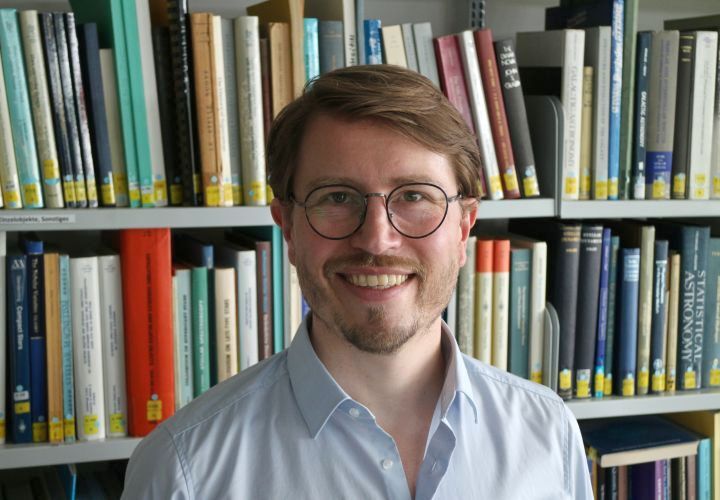
Göttingen University secures Lower Saxony Impulse Professorship
The University of Göttingen has secured a Lower Saxony Impulse Professorship. This funds the appointment of the renowned astrophysicist Professor Dr Richard I. Anderson to the Chair in Observational Cosmology. The funding is around two million euros over the next five years. At the end of this period, the Faculty of Physics will take on the professorship.

AI research for more precise particle-physics simulations receives funding
The University of Göttingen has been awarded around 1.8 million euros for a new AI research group in the programme “KI-Forschungsgruppen Niedersachsen” funded by zukunft.niedersachsen. The five-year project “Production-ready AI for unbiased simulation in high energy physics” will be led by Dr Timo Janßen at the Institute for Theoretical Physics. It aims to make computer simulations of high-energy particle collisions much faster while preserving the scientific accuracy that is essential for research at CERN’s Large Hadron Collider and its upcoming high-luminosity phase.

On the trail of the mysteries of the Universe: cosmic data open to all
Following the completion of the largest survey of the early Universe to date, the team behind the Hobby-Eberly Telescope Dark Energy Experiment (HETDEX) has made its extensive dataset available to the public. With half a petabyte of data, researchers and astronomy enthusiasts alike can now investigate how the first galaxies formed and evolved, measure the distribution of stars and gas, map the cosmos, and explore objects that are difficult to find in conventional databases.
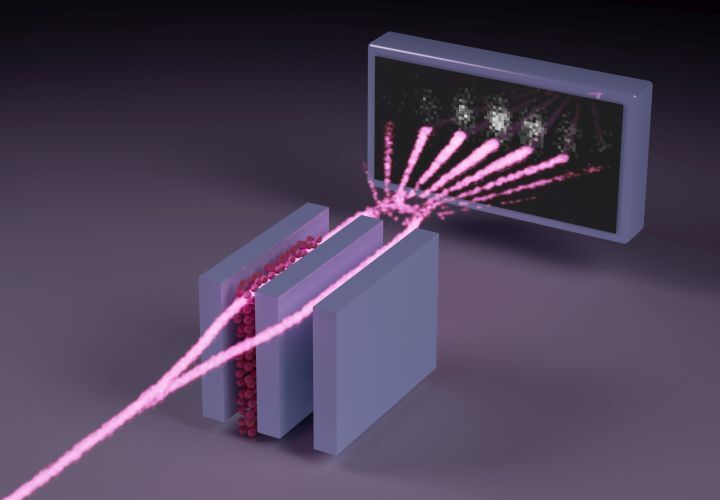
Double-slit experiment reveals hidden details between light and matter
A similar effect to that of light being refracted by raindrops to create rainbows, underlies many everyday technologies, like LCD screens and broadband connections based on fibre-optic cables. Light refraction is caused by an interaction between light and the atoms of matter. This brings the light waves slightly out of sync. “X-ray light” is “refracted”, too. But the effect is difficult to measure. A miniature device now offers a novel approach: the world's smallest X-ray interferometer.
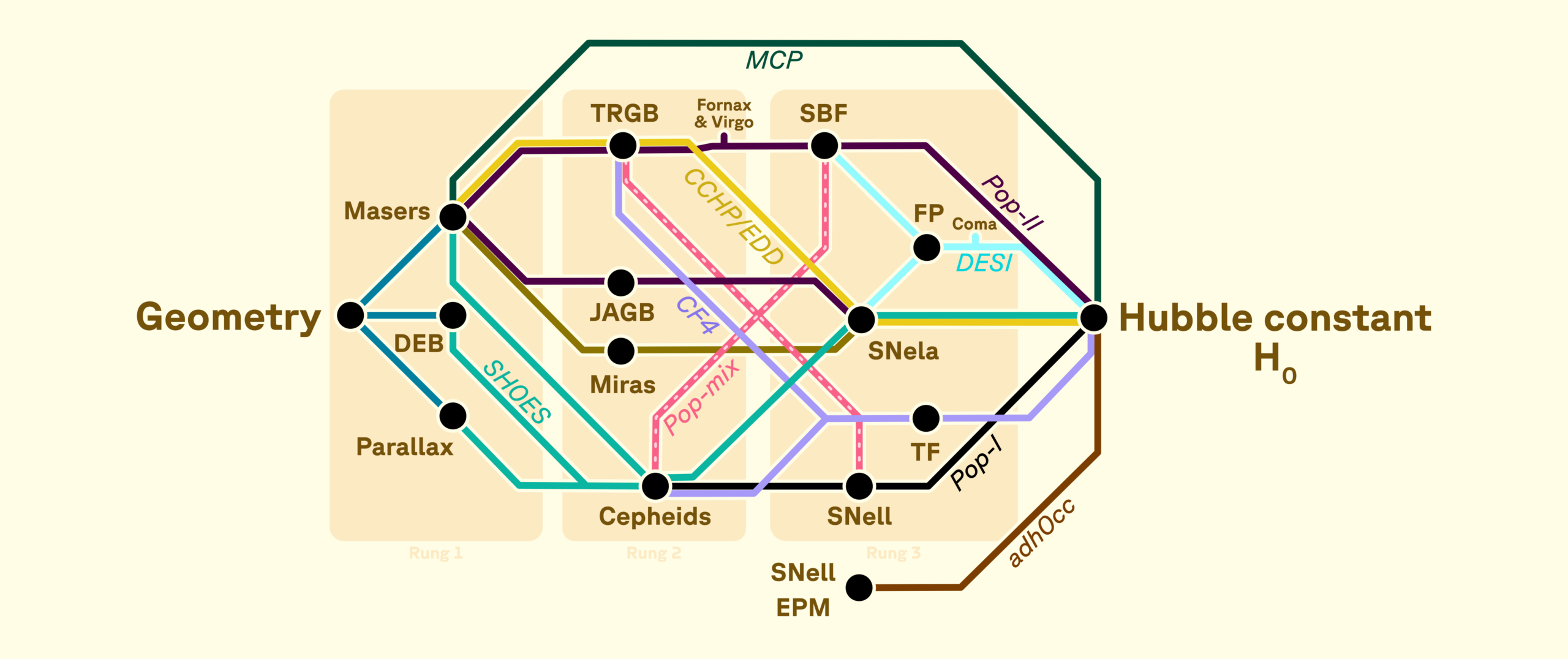
Hubble constant measured with 1% precision
An international collaboration of astronomers, including Prof. Richard Anderson, has achieved the most precise direct measurement to date of the current expansion rate of the Universe. In a paper to be published in Astronomy & Astrophysics, the H0 Distance Network (H0DN) Collaboration reports a value of the Hubble constant of H0 = 73.50 ± 0.81 km s⁻¹ Mpc⁻¹, corresponding to a precision of just over 1%.
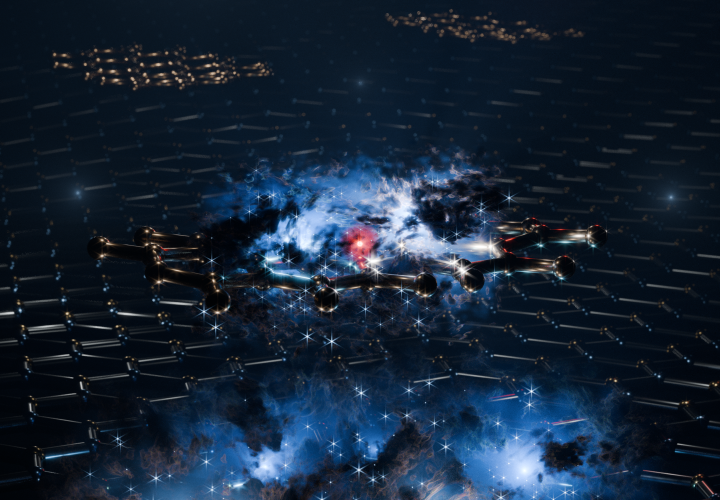
Hybrid excitons: combining the best of both worlds
Faster, more efficient, and more versatile – these are the expectations for the technology that will produce our energy and handle information in the future. But how can these expectations be met? A major breakthrough in physics has now been made by researchers who combined two highly promising types of material – organic semiconductors and two-dimensional semiconductors. Their findings hold promise for developing new technology such as the next generation of solar cells.
PhysicsWorld: Göttingen in top ten publications of the year
PhysicsWorld has included a publication by the University of Göttingen in its list of the ten most important breakthroughs of 2025. In January, an international research team led by the Institute for Astrophysics and Geophysics published research about the weather on the exoplanet “WASP-127b”. The discovery helps to better understand the atmospheres of planets outside our solar system.

European Tensor Network School 2025
The Institute for Theoretical Physics will host the European Tensor Network School 2025 (TENSOR25) from November 17 – 21, 2025. Tensor networks are the mathematical framework for state-of-the-art computational methods for quantum many-body systems and are widely used to study ground-state properties, nonequilibrium physics, and dynamical properties of strongly correlated systems in low dimensions. The theory of the methods is rooted in quantum information theory and the methods' further applications include solving partial differential equations, quantum computing, and quantum chemistry. The school takes place every year and is intended for doctoral students who are new to the field. About 70 participants from all over Europe will attend TENSOR25 in November 2025 at Pauliner church.
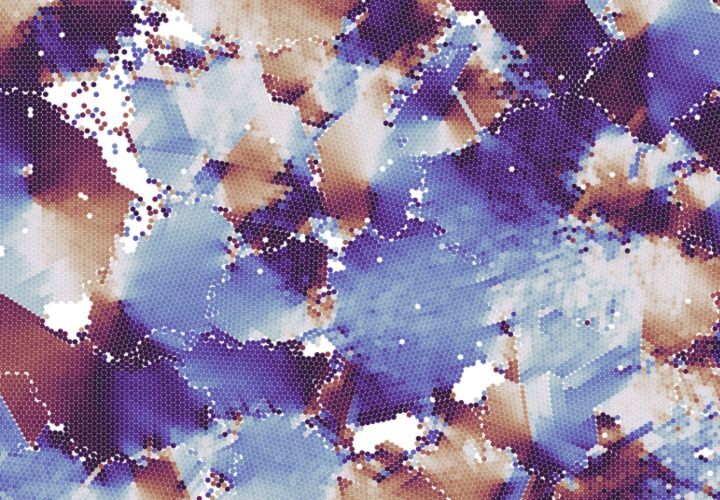
Funding for training and research in biological complexity
Complex biological systems are more than the sum of their parts – their properties emerge from the dynamic interaction of their components, such as molecules or cells. PhD researchers now have the opportunity to develop their own theoretical perspective on these systems as part of an international Doctoral Network. A European consortium initiated by researchers from the University of Göttingen, the Max Planck Institute for Dynamics and Self-Organization (MPI-DS), and the University of Edinburgh has been awarded €4.5M by Marie Skłodowska-Curie Actions to coordinate the network. The network consists of twelve European universities and research centres along with a number of partners outside academia.
Events
Physics Colloquium
On Monday in lecture hall HS2.
Exhibitions

Faculty of Physics
Friedrich-Hund-Platz 1
Floor B.01, Room 102
D-37077 Göttingen
Tel. +49 (0)551 3924095
Fax +49 (0)551 3924583
dekanat@phys.uni-goettingen.de